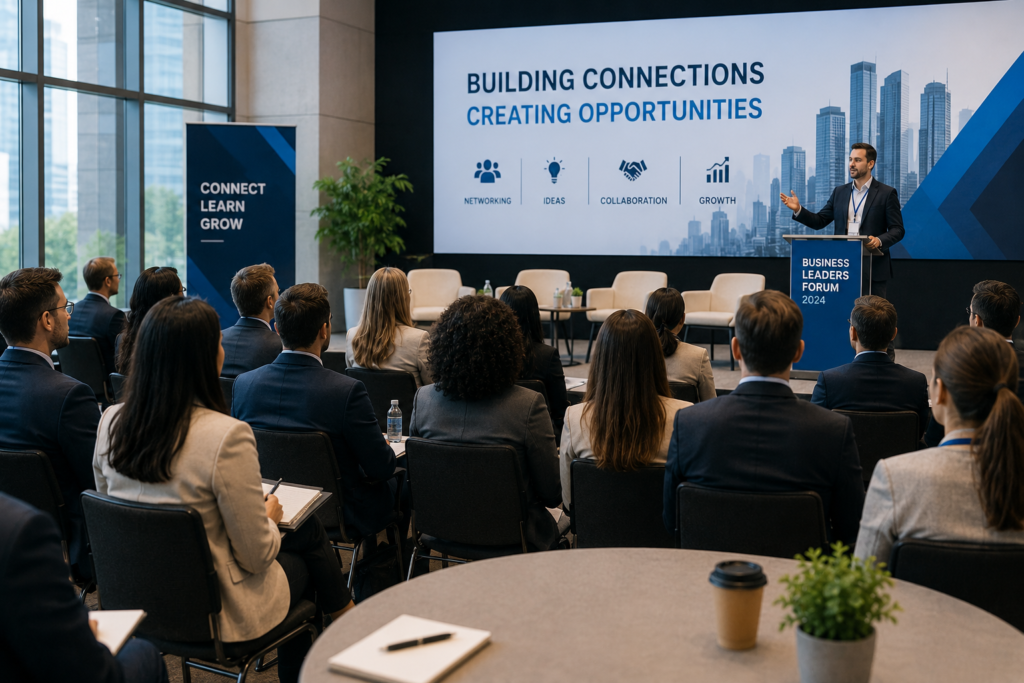
Business has changed significantly in recent years, but one thing has remained important: people still value the opportunity to meet, talk and exchange ideas in person.
Business Events provide a space for those interactions to happen. Conferences, industry gatherings, networking events, business discussions and smaller professional meetups can bring together people who may have different experiences but share an interest in learning, building relationships or exploring new opportunities.
The value of a professional event is not simply measured by the number of people in the room. What matters is what happens through the conversations, ideas and relationships that develop around it.
Why Business Events Still Matter
Digital communication has made it easier than ever to connect with people. Meetings can happen online, information can be shared instantly and professionals can build networks without being in the same location.
Yet digital communication does not completely replace face-to-face interaction.
Meeting someone in person creates an opportunity to understand their communication style, interests and perspective in a way that can be difficult to capture through a short email or online message.
Business Events also create a shared environment. People are gathered around a particular topic, industry or purpose, which makes it easier to begin conversations and discover common interests.
For many professionals, an event can be the starting point for a relationship that continues long after the event itself has ended.
Events Create Opportunities for Meaningful Conversations
One of the greatest strengths of Business Events is the opportunity for conversations that might not happen during an ordinary workday.
A conference session might introduce a new idea. A networking reception might lead to a conversation with someone from another industry. A panel discussion might encourage people to look at a familiar challenge from a different perspective.
These interactions can be valuable even when they do not immediately result in a business deal.
Sometimes the most useful outcome is simply learning something new or meeting someone whose experience offers a different way of thinking.
That exchange of ideas is an important part of professional development.
Business Events and Business Networking
Networking is naturally connected to Business Events, but effective networking is about more than collecting contacts.
A good event gives people an opportunity to build relationships gradually.
Instead of trying to meet everyone, professionals can focus on having a few genuine conversations. Asking thoughtful questions, listening carefully and finding common ground can make those conversations more meaningful.
The relationship may continue through a follow-up message, another event or a shared professional interest.
Over time, these connections can become valuable sources of knowledge, introductions, collaboration and new opportunities.
Bringing Different Perspectives Together
Businesses often benefit when people with different experiences come together.
Professionals from different companies or industries may approach the same problem in completely different ways. An event creates an environment where those perspectives can be exchanged.
For example, a technology professional might see a business challenge differently from someone working in marketing, finance or operations. Bringing these perspectives together can lead to ideas that would not have emerged within a single professional circle.
This is one reason industry conferences and cross-industry networking events can be valuable.
They expand the conversation beyond the boundaries of an individual organization.
The Role of Events in New York’s Business Community
New York is home to professionals, entrepreneurs, organizations and businesses across a wide range of industries.
That diversity creates a strong environment for Business Events and business conversations. People working in finance, technology, media, marketing, real estate, consulting, creative industries and many other fields regularly interact within the city’s broader professional community.
For professionals in New York, attending the right event can provide an opportunity to meet people outside their immediate network and learn more about developments happening across different industries.
The most valuable events are not necessarily the largest ones. Smaller gatherings can sometimes create more meaningful conversations because attendees have more opportunities to interact directly.
What Makes a Professional Event Valuable?
A successful professional event does not have to be complicated.
Several factors can contribute to a valuable experience:
- Relevant people: Attendees should have a genuine connection to the subject or purpose of the event.
- Useful conversations: Participants should have opportunities to exchange ideas rather than simply listen.
- Good organization: Clear communication and a well-planned experience make it easier for people to focus on the event.
- Opportunities to connect: Time for informal conversations can be just as valuable as scheduled sessions.
- Useful information: Speakers and discussions should give attendees ideas they can take back into their professional lives.
Ultimately, the value of an event comes from the experience it creates for the people attending.
Making the Most of a Professional Event
Attending an event is only part of the process. Preparation can make the experience much more productive.
Before attending, it can help to understand the purpose of the event and identify topics or people that are particularly relevant to your interests.
During the event, focus on being present rather than trying to move quickly from one conversation to another.
Afterwards, follow up with people you genuinely connected with.
A short message mentioning something specific from your conversation can make a much stronger impression than a generic follow-up.
The goal is not to turn every interaction into an immediate opportunity. It is to create relationships that can develop naturally over time.
Events Can Support Long-Term Business Relationships
The most valuable result of a professional event may happen weeks or months later.
A conversation at an event can lead to a future introduction, collaboration, partnership or exchange of ideas. Sometimes the connection simply becomes part of a person’s broader professional network.
This is why events should be viewed as part of a longer relationship-building process rather than isolated occasions.
The event creates the opportunity. What happens afterward determines whether that opportunity develops into something meaningful.
The Future of Business Events
The future of professional events is likely to involve a combination of in-person and digital experiences.
Technology can make events more accessible and help people stay connected before and after a gathering. At the same time, in-person interaction continues to provide something that digital communication cannot completely reproduce.
The most effective events will likely be those that use technology to support human connection rather than replace it.
Whether an event takes place in a large conference venue or a smaller professional setting, the fundamental purpose remains similar: bringing people together around ideas, experiences and opportunities to connect.
Final Thoughts
Business Events continue to play an important role in modern business because business is ultimately built around people.
Technology can make communication faster, but meaningful relationships still depend on conversation, trust and shared experiences.
A well-designed professional event can create opportunities to learn, meet new people, exchange ideas and discover perspectives that may not be available within an everyday professional routine.
For professionals, entrepreneurs and business leaders, the real value of attending an event is often what happens beyond the schedule—the conversation after a session, the introduction between two people or the relationship that continues long after everyone has gone home.
That is what makes professional events more than gatherings. They can become starting points for ideas, relationships and opportunities.